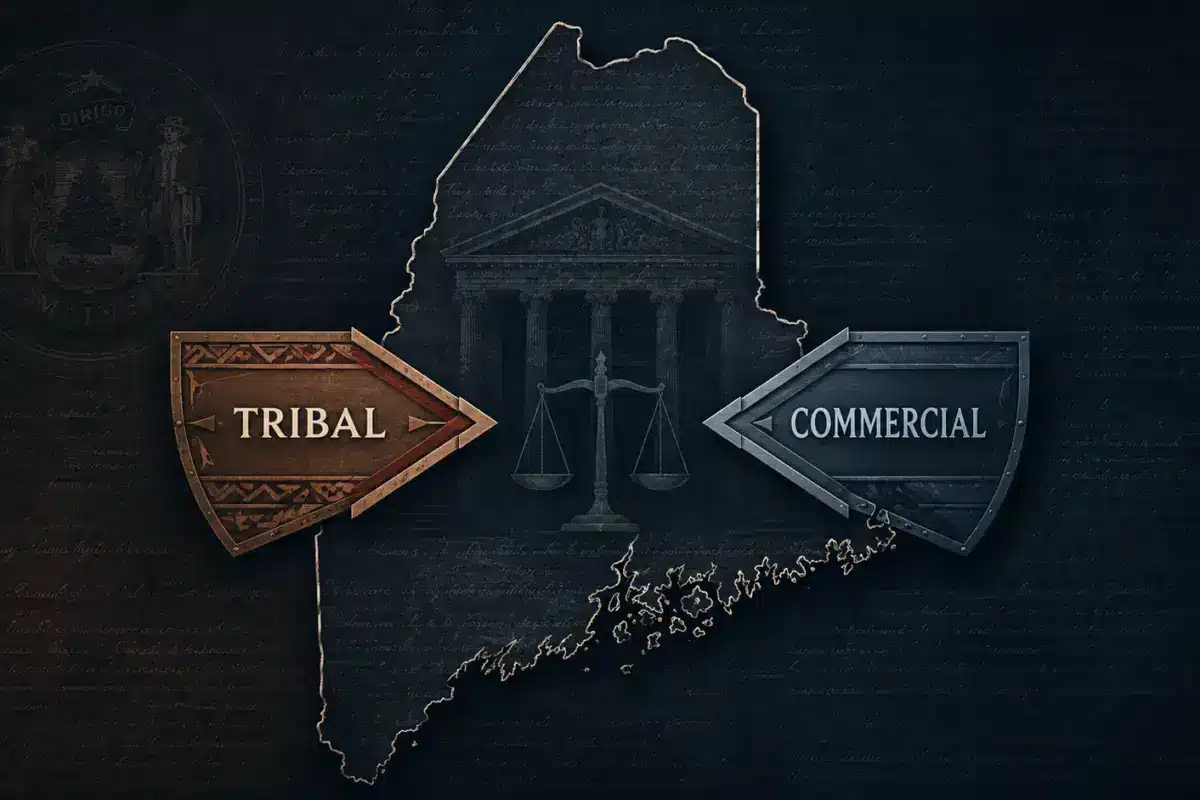
Oxford Casino Hotel, Maine’s largest commercial casino and a subsidiary of Churchill Downs Incorporated, filed a federal lawsuit on January 23, 2026, challenging the state’s new online gambling law. The law — LD 1164, “An Act to Create Economic Opportunity for the Wabanaki Nations Through Internet Gaming” — took effect on January 11, 2026, after Governor Janet Mills declined to veto it. It grants exclusive iGaming licensing rights to Maine’s four federally recognized Wabanaki Nations: the Penobscot Nation, the Passamaquoddy Tribe, the Houlton Band of Maliseet Indians, and the Mi’kmaq Nation. Commercial operators are shut out of the online market entirely.
Oxford’s complaint, filed in U.S. District Court for the District of Maine and naming Gambling Control Unit Executive Director Milton F. Champion as defendant, argues the carveout violates the Equal Protection Clauses of both the U.S. and Maine constitutions, plus the Commerce Clause. In April 2026, the four Wabanaki Nations filed to intervene in the case. The outcome has implications for every state considering tribal-priority iGaming frameworks — including New York and California.
What LD 1164 Does
LD 1164 authorizes regulated online casino gaming in Maine — slots, table games, poker, live dealer — exclusively through the four Wabanaki Nations. Each tribe can partner with one iGaming platform operator. The law sets a 16% tax on gross gaming revenue directed to state programs. Players must be 21+ and physically located in Maine (geolocation verified). The law took effect January 11, 2026, with online operations expected to launch approximately 90 days after the end of the 2026 legislative session.
Governor Mills allowed the bill to become law without her signature — she did not sign it and did not veto it. This is notable because both her office and Maine Gaming Control Board Chairman Steve Silver had previously testified against the expansion, with Silver calling it “ill-advised.” The bill passed despite that opposition.
The tribal nations already hold exclusive online sports betting rights in Maine, operating through partnerships with Caesars and DraftKings. LD 1164 extends that tribal exclusivity model to casino games.
Why Oxford Filed Suit
Churchill Downs has operated Oxford Casino Hotel since 2013. The property sits on Route 26 in Oxford, about 35 miles north of Portland. Together with Penn Entertainment’s Hollywood Casino Hotel & Raceway in Bangor, it represents Maine’s entire commercial casino footprint. Both commercial casinos testified against LD 1164 throughout the legislative process.
The lawsuit’s core position is paradoxical — and Oxford acknowledges this. Churchill Downs is a founding member of the National Association Against iGaming (NAAiG), a group that lobbies nationally against online casino expansion. Oxford would prefer no online casinos in Maine at all. But if the state is going to legalize iGaming, Oxford argues it should have a fair shot at competing. Spending years lobbying against legalization, then suing for the right to participate in the legalization you opposed — the irony isn’t lost on the tribal nations, who pointed this out publicly.
Oxford’s filing cites industry research estimating that iGaming introduction reduces land-based casino revenue by approximately 16%. For Maine, that projects to 378 lost jobs statewide, roughly $60 million in lost economic value, and approximately $22 million in lost labor income. These figures come from NAAiG-associated research — take them with a grain of salt given the source, but the directional concern (online cannibalizing land-based) is consistent with data from states like New Jersey and Pennsylvania. In PA, land-based revenue dipped initially post-iGaming launch, then stabilized. The catastrophic scenarios NAAiG predicts haven’t materialized elsewhere.
The Legal Arguments
Oxford’s complaint rests on three constitutional claims:
- Equal Protection (U.S. Constitution, 14th Amendment): The law grants a commercial privilege exclusively to entities defined by race/tribal membership, excluding non-tribal businesses from participation. Oxford argues this constitutes race-based discrimination requiring strict scrutiny.
- Equal Protection (Maine Constitution): Same argument under state constitutional provisions.
- Commerce Clause: The law discriminates against out-of-state businesses (Churchill Downs is Kentucky-based) by reserving the iGaming market for in-state tribal entities, potentially violating the dormant Commerce Clause.
The tribal nations counter that their sovereignty — grounded in the Indian Gaming Regulatory Act and the Maine Indian Claims Settlement Act — provides constitutional justification for preferential treatment. The relationship between state governments and federally recognized tribes has its own legal framework that doesn’t map neatly onto standard equal protection analysis. This is genuinely complicated constitutional law, not a straightforward discrimination case.
This article is for informational purposes only and does not constitute legal analysis. The case is active and its outcome is uncertain.
The Tribal Response
The Wabanaki Nations intervened formally in April 2026. Their position: the lawsuit is hypocritical. Commercial casinos held a monopoly on Maine gambling for over 25 years before tribal online gaming was authorized. A Passamaquoddy Tribe chief publicly praised Governor Mills as “the greatest ever” after LD 1164 took effect. The tribes view the law as partial economic justice after decades of exclusion from gaming revenue that flows through their ancestral lands.
The tribes also argue the lawsuit threatens the legal foundation of tribal sovereignty more broadly — if courts rule that tribal-exclusive frameworks violate Equal Protection, it could undermine tribal gaming compacts in other states. This elevates the case beyond Maine into a national precedent question.
Precedent from Other States
Tribal-exclusive or tribal-priority iGaming frameworks aren’t unique to Maine. Connecticut’s iGaming market operates through Mohegan Sun and Foxwoods — both tribal casinos. Florida‘s Seminole Compact grants mobile sports betting exclusively to Hard Rock Bet. California’s failed Proposition 27 (2022) proposed tribal-priority online sports betting. The pattern of states granting tribes preferential or exclusive online gaming rights is growing, not shrinking.
What makes Maine’s case different is that it’s being challenged constitutionally. If Oxford wins, it could create a precedent making tribal-exclusive frameworks harder to sustain in future state legislation. If the tribes win, it solidifies the model. Every state legislature watching iGaming expansion — New York, California, Illinois — has a stake in this outcome.
What This Means for Maine Players
No online casino has launched in Maine yet. LD 1164 set the legal framework, but the actual platforms won’t go live until approximately 90 days after the 2026 legislative session ends. The lawsuit introduces additional uncertainty — if Oxford obtains an injunction, launch could be delayed indefinitely.
In the meantime, Maine residents who want to play online casino games continue to use offshore casinos. Bovada, BetOnline, and Ignition all accept Maine players. This situation — legal framework passed but not yet operational — is exactly the kind of gap that offshore operators have filled for two decades across the US. For the full legal context, see our guide to US online gambling legality.
Timeline
| Date | Event |
|---|---|
| 2025 legislative session | LD 1164 passes Maine legislature |
| January 11, 2026 | LD 1164 takes effect (Gov. Mills declined to veto) |
| January 23, 2026 | Churchill Downs / Oxford Casino files federal lawsuit |
| April 2026 | Wabanaki Nations file to intervene in the case |
| ~Q3/Q4 2026 | Expected launch window for tribal iGaming platforms (if no injunction) |
| 2027–2028 (estimated) | Federal court resolution (federal cases typically take 12-24 months minimum) |
[FACT-CHECK NEEDED: verify whether any motions for preliminary injunction have been filed as of publication date. An injunction would delay launch significantly.]
FAQ
Is online gambling legal in Maine right now?
LD 1164 authorizes online casino gaming through the four Wabanaki Nations, but no platforms have launched yet. Online sports betting is already operational through tribal partnerships with Caesars and DraftKings. Offshore casinos remain available to Maine residents in the standard federal grey area.
Who can launch online casinos in Maine?
Under LD 1164, only the four Wabanaki Nations (Penobscot, Passamaquoddy, Maliseet, Mi’kmaq) can operate iGaming. Each can partner with one platform operator. Commercial casinos like Oxford and Hollywood Casino are excluded from the online market.
When will Maine online casinos launch?
Approximately 90 days after the end of the 2026 legislative session — likely Q3 or Q4 2026. The Oxford lawsuit introduces uncertainty. If an injunction is granted, launch could be delayed.
What is the Oxford lawsuit about?
Churchill Downs (parent of Oxford Casino) is challenging LD 1164 as unconstitutional. The complaint argues tribal-exclusive iGaming rights violate Equal Protection and Commerce Clause provisions. Oxford characterizes the law as a “race-based monopoly.”
Can Maine players use offshore casinos?
Yes. Offshore casinos like Bovada, BetOnline, and Ignition accept Maine players. This operates in the same federal grey area as every other state without regulated iGaming. See our best online casinos for US players for the full ranking.
What does this case mean for other states?
If Oxford wins, tribal-exclusive frameworks become harder for other states to implement. If the tribes win, the model is validated. States like New York and California — both considering tribal-priority iGaming — are watching closely.
This article reflects information available as of May 2026. The case is active in U.S. District Court for the District of Maine. Developments may change the analysis presented here. This is not legal advice.