
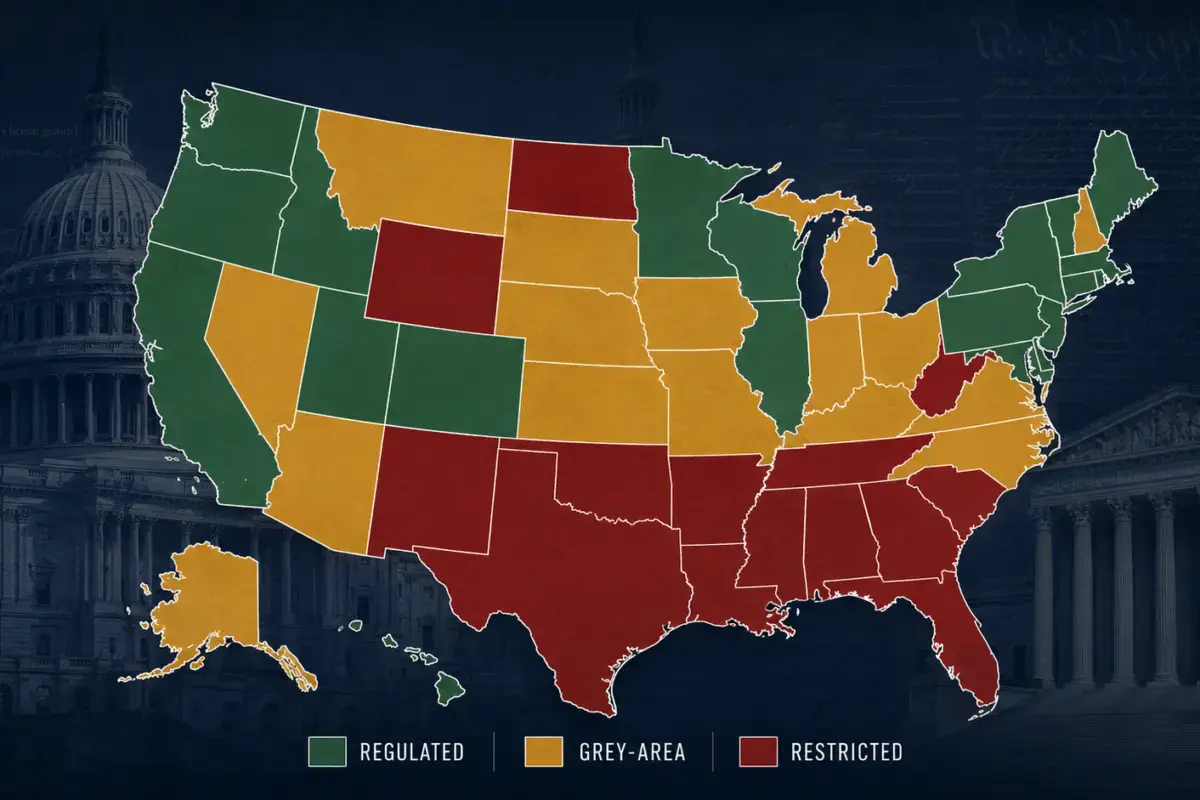
Is online gambling legal in the USA? It’s not a yes-or-no answer — it’s a layered system where federal laws set the framework and individual states decide what’s specifically permitted within their borders. As of 2026, seven states have operational regulated online casinos (New Jersey, Pennsylvania, Michigan, West Virginia, Connecticut, Delaware, Rhode Island), Maine has legalized but hasn’t launched yet, 39 states plus DC allow legal sports betting, and the remaining states either explicitly restrict online gambling or exist in a grey area where offshore casinos operate without clear prohibition or endorsement. This guide covers the federal laws, the state picture, and where offshore fits. Not legal advice — consult a licensed attorney in your state for binding questions.
Quick Answer: Is Online Gambling Legal in the USA?
It depends on where you live, what type of gambling, and whether you mean regulated or offshore. In 7 states you can legally play online casino games through licensed operators. In 31 states plus DC you can legally bet on sports through statewide mobile apps. In every other state, online casino gambling exists in a grey area — not explicitly legal, rarely enforced against individual players, and primarily accessed through offshore operators based outside the US.
This page is for informational purposes only and does not constitute legal advice. Laws change. Consult a licensed attorney in your state for specific legal questions. This page is updated periodically but may not reflect the most recent legislative changes.
The 50-State Online Gambling Legality Map (2026)
The one-screen version. Regulated online casinos run in just 7 states (plus Maine, launching in 2026); regulated online sports betting is live in 33 jurisdictions; everywhere else, players reach casino games through offshore sites in the grey zone. Here is all 50 states plus DC, current for 2026.
| State | Online casino | Online sports betting |
|---|---|---|
| Alabama | Offshore only | None |
| Alaska | Offshore only | None |
| Arizona | Offshore only | Online — live |
| Arkansas | Offshore only | Online — live |
| California | Offshore only | None |
| Colorado | Offshore only | Online — live |
| Connecticut | Regulated | Online — live |
| Delaware | Regulated | Online — live |
| District of Columbia | Offshore only | Online — live |
| Florida | Offshore only | Online — live |
| Georgia | Offshore only | None |
| Hawaii | Offshore only | None |
| Idaho | Offshore only | None |
| Illinois | Offshore only | Online — live |
| Indiana | Offshore only | Online — live |
| Iowa | Offshore only | Online — live |
| Kansas | Offshore only | Online — live |
| Kentucky | Offshore only | Online — live |
| Louisiana | Offshore only | Online — live |
| Maine | Launching 2026 | Online — live |
| Maryland | Offshore only | Online — live |
| Massachusetts | Offshore only | Online — live |
| Michigan | Regulated | Online — live |
| Minnesota | Offshore only | None |
| Mississippi | Offshore only | Retail only |
| Missouri | Offshore only | Online — live |
| Montana | Offshore only | Retail only |
| Nebraska | Offshore only | Retail only |
| Nevada | Offshore only | Online — live |
| New Hampshire | Offshore only | Online — live |
| New Jersey | Regulated | Online — live |
| New Mexico | Offshore only | Retail only |
| New York | Offshore only | Online — live |
| North Carolina | Offshore only | Online — live |
| North Dakota | Offshore only | Retail only |
| Ohio | Offshore only | Online — live |
| Oklahoma | Offshore only | None |
| Oregon | Offshore only | Online — live |
| Pennsylvania | Regulated | Online — live |
| Rhode Island | Regulated | Online — live |
| South Carolina | Offshore only | None |
| South Dakota | Offshore only | Retail only |
| Tennessee | Offshore only | Online — live |
| Texas | Offshore only | None |
| Utah | Offshore only | None |
| Vermont | Offshore only | Online — live |
| Virginia | Offshore only | Online — live |
| Washington | Offshore only | Retail only |
| West Virginia | Regulated | Online — live |
| Wisconsin | Offshore only | Legal, not live |
| Wyoming | Offshore only | Online — live |
How to read it: Online casino — “Regulated” = state-licensed iGaming available; “Offshore only” = no state-licensed online casino, so residents use offshore sites (the grey zone explained below). Online sports betting — “Online — live” = legal mobile/online books; “Retail only” = in-person sportsbooks but no apps; “Legal, not live” = passed but not launched (Wisconsin); “None” = no legal sports betting. Montana’s app works only inside licensed venues, so it’s listed as retail. Sources: state regulators and operator data compiled by Casino Monkey, May–June 2026. A tracker, not legal advice — laws change.
Federal Laws That Govern Online Gambling
Three federal statutes and two major legal decisions form the backbone of US online gambling law. None of them were written for the internet as it exists today — they’ve been reinterpreted, challenged, and partially overturned over decades. Understanding them is necessary to understand everything else on this page.
Wire Act of 1961 (18 U.S.C. § 1084)
The Wire Act was signed by President Kennedy to combat organized crime’s use of telephone wire services for sports betting. It prohibits using wire communications to transmit bets or wagering information across state lines. Written in 1961, it predates the internet by three decades. Its application to online gambling has been debated, reversed, and re-reversed at the federal level.
UIGEA 2006 — Unlawful Internet Gambling Enforcement Act (31 U.S.C. § 5361-5367)
The UIGEA is the most misunderstood gambling law in the US. Here’s what it actually does: it prohibits financial institutions (banks, payment processors, credit card companies) from knowingly processing transactions related to unlawful internet gambling. Here’s what it does NOT do: it does not make it illegal for an individual player to place a bet on an offshore casino. The law targets the money pipeline, not the person at the keyboard.
This distinction matters enormously. When your Visa deposit to an offshore casino gets declined, that’s UIGEA in action — your bank blocking the transaction. When nothing happens to you legally after playing at Bovada for five years, that’s also UIGEA in action — because the law wasn’t designed to criminalize players. The UIGEA also explicitly exempts state-regulated gambling, which is how PA, NJ, and MI operate their licensed online casinos without running afoul of federal law.
2011 DOJ Opinion — Wire Act Narrowed to Sports
In 2011, the Department of Justice’s Office of Legal Counsel issued an opinion concluding that the Wire Act applied only to sports betting — not to online casino games, poker, or lottery. This opinion opened the door for states to legalize online gambling. New Jersey and Delaware launched regulated online casinos in 2013 largely because this opinion cleared the federal pathway.
2018 DOJ Reversal
In 2018, the DOJ under the Trump administration reversed the 2011 opinion, taking the position that the Wire Act applies broadly to all forms of interstate online gambling — not just sports. This reversal created legal uncertainty for state-regulated iGaming operators. The 1st Circuit Court of Appeals subsequently ruled in 2019 (in a case brought by the New Hampshire Lottery) that the Wire Act is limited to sports betting, siding with the 2011 interpretation.
PASPA Repeal 2018 — Murphy v. NCAA
The Professional and Amateur Sports Protection Act (PASPA) of 1992 had effectively banned sports betting nationwide except in Nevada. In May 2018, the Supreme Court struck down PASPA in Murphy v. NCAA, ruling that the federal government cannot prohibit states from authorizing sports betting. This decision didn’t legalize sports betting everywhere — it gave each state the authority to decide for itself. Within 5 years, 38+ states had passed sports betting legislation.
States with Legal Regulated Online Casinos
As of May 2026, seven states have fully operational regulated online casino markets. Maine has legalized iGaming but has not yet launched.
| State | Legal Since | Operators | Key Stat |
|---|---|---|---|
| New Jersey | 2013 | ~30 licensed | $2.91B iGaming revenue 2025 |
| Delaware | 2013 | 3 (limited) | Smallest market, Lottery-operated |
| Pennsylvania | 2019 | 15+ | 54% slot tax — highest in US |
| Michigan | 2021 | 15+ | Fast-growing, tribal + commercial |
| West Virginia | 2020 | 5+ | Small market, partnership-based |
| Connecticut | 2021 | 2 (Mohegan Sun + Foxwoods) | Tribal-exclusive market |
| Rhode Island | 2024 | 1 (Bally’s exclusive) | 50% slot tax, newest market |
| Maine | 2026 (legalized) | Up to 4 tribal licences | Not yet launched |
These 7+1 states generated roughly $8.4 billion in combined iGaming revenue in 2024, growing approximately 29% year-over-year. New Jersey and Pennsylvania are the two largest markets by revenue. If you live in one of these states, you have access to licensed, regulated, state-audited online casinos — the safest option available to US players, full stop.
States with Legal Sports Betting but No Online Casinos
This is where most of the confusion lives. 39 states plus DC allow some form of legal sports betting (mobile, retail, or both); our state-by-state sports betting table has each one’s launch date, age limit and source. Far fewer allow online casino games. New York is the most prominent example — legal mobile sports betting since January 2022 with DraftKings, FanDuel, and others processing billions in wagers. But DraftKings Casino? Not available in NY. The sports betting licence doesn’t extend to casino games. Different legislation, different regulatory framework.
Players in these states who want online casino games have the same two options as players in fully restrictive states: wait for legislation, or use offshore.
States in the Grey Zone — Where Offshore Operates
The majority of US states fall into this category: no regulated online casinos, no specific statute criminalizing individual players who use offshore sites, and no enforcement history against residents who do. California, Texas, Florida, and Georgia are all examples — as is Wyoming, which despite its tiny population ranks #2 nationally in online casino search interest.
The grey area exists because the UIGEA targets financial institutions, not players. State gambling statutes were largely written to address operators, not participants. And federal enforcement resources are focused on operators who run unlicensed gambling businesses — not individual bettors. The result is a practical reality where millions of Americans use offshore casinos without legal consequence, in a framework that’s technically ambiguous but functionally tolerant.
To be clear: “functionally tolerant” is not “explicitly legal.” It’s a description of enforcement patterns, not a legal guarantee. For a deeper look at how the offshore model works, see our offshore vs regulated casinos guide.
Offshore Casinos and US Law — What’s Actually Prohibited
The legal picture for offshore casinos has three layers:
- Operating an offshore casino targeting US players: potentially violates federal law (Wire Act, UIGEA) for the operator. DOJ has prosecuted operators in the past (notably PokerStars/Full Tilt in 2011’s “Black Friday”).
- Processing payments for offshore gambling: prohibited for US financial institutions under UIGEA. This is why card deposits get declined and why crypto has become the default payment method at offshore sites.
- Using an offshore casino as an individual US player: not explicitly criminalized by federal law. No federal statute makes it a crime for a person to place a bet on an offshore site. Some state laws technically prohibit gambling broadly, but enforcement against individuals is essentially non-existent.
The practical reality: the player-side risk is legal ambiguity, not legal jeopardy. Operators carry the real legal risk. Players carry financial risk (the casino could refuse to pay) and regulatory risk (no state protection if something goes wrong). That’s the trade-off.
Tribal Casinos and Online Gambling
The Indian Gaming Regulatory Act (IGRA) of 1988 established the framework for tribal gaming in the US. Tribes operate casinos on sovereign land under compacts negotiated with state governments. Online gambling adds complexity: some tribes have negotiated online compacts (Connecticut’s Mohegan Sun and Foxwoods operate iGaming under tribal agreements), while others oppose online expansion because it threatens their physical casino monopolies.
Maine’s 2026 iGaming law is notable because it grants exclusive online casino licences to the state’s four Wabanaki Nations — the first US iGaming market built entirely on tribal authority. This model could influence how other states with significant tribal gaming interests approach online expansion.
Cryptocurrency and Online Gambling
UIGEA’s payment restrictions created the conditions for crypto adoption at offshore casinos. When banks block card transactions, players need an alternative. Bitcoin, Ethereum, and other cryptocurrencies bypass the banking system entirely — the transaction goes from player wallet to casino wallet without a US financial institution involved.
Is using crypto at an offshore casino legal? Owning and transferring cryptocurrency is legal throughout the US. Using crypto for gambling falls into the same grey area as the gambling itself — the transaction method doesn’t change the legal status of the underlying activity. Federal enforcement of crypto gambling transactions against individual players is effectively non-existent. For a full walkthrough on using Bitcoin at online casinos, we have a dedicated guide.
Tax Implications — Yes, You Owe Taxes
Online gambling winnings are taxable income in the United States regardless of whether they come from a regulated casino, an offshore site, or a crypto transaction. The IRS treats gambling winnings as ordinary income subject to federal income tax.
At regulated casinos, the casino issues W-2G forms above a reporting threshold that is $2,000 for payments made in 2026, indexed after that (it was $1,200 for slots and bingo before the 2025 tax law). At offshore casinos, no W-2G is issued. The tax obligation still exists — the reporting burden falls on the player. And from tax year 2026, only 90% of gambling losses are deductible, and only if you itemize. The IRS expects a gambling diary: dates, amounts wagered, amounts won or lost, per session. The full picture, with the IRS wording and the crypto and FBAR questions, is in our guide to taxes on offshore gambling winnings.
State income taxes on gambling vary. Pennsylvania charges 3.07% on gambling winnings. Some states (Florida, Texas, Nevada) have no state income tax. Consult a tax professional in your state.
2026 Legislative Outlook
Several states have active or recently introduced iGaming legislation in 2026. New York’s Senator Joseph Addabbo has reintroduced iGaming bills, though none have reached a floor vote. Illinois and Ohio has companion bills in both chambers (HB 4797 and SB 3723) — notable because Illinois leads the entire US in online casino search volume. Virginia advanced an online casino bill out of committee with responsible gaming provisions. Massachusetts has multiple filed bills. California and Texas show no meaningful movement.
Maine’s tribal iGaming market is expected to launch in mid-2026, which would make it the 8th operational market. The pace of iGaming expansion has slowed significantly compared to the post-PASPA sports betting wave — only Rhode Island (2024) and Maine (2026) have passed iGaming legislation in recent years.
FAQ
Is online gambling legal in all 50 states?
No. Seven states have operational regulated online casinos: NJ, PA, MI, WV, CT, DE, RI. Maine has legalized but not launched. 39 states plus DC allow sports betting. The remaining states either restrict or exist in a grey area regarding online casino gambling.
What is UIGEA in simple terms?
The Unlawful Internet Gambling Enforcement Act (2006) makes it illegal for banks and payment processors to handle transactions for unlawful online gambling. It does NOT make it illegal for you, the individual player, to place a bet online. It targets the money pipeline, not the person at the keyboard.
Is the Wire Act about online casinos?
The Wire Act of 1961 was written about telephone sports betting. Its application to online casinos has been debated at the federal level. The current controlling interpretation (1st Circuit, 2019) limits the Wire Act to sports betting. The DOJ’s position has shifted between administrations.
Can I get arrested for using offshore casinos?
No US player has been federally prosecuted for using an offshore casino as an individual bettor. The UIGEA targets financial institutions, not players. State gambling laws focus on operators. The practical risk is financial (casino doesn’t pay), not criminal. That said, the legal picture is technically ambiguous — this is not legal advice.
Are crypto casinos legal in the US?
Owning and transferring cryptocurrency is legal. Using crypto at an offshore casino falls into the same grey area as using the casino itself. The payment method doesn’t change the legal status of the underlying activity. Federal enforcement against individual crypto gambling transactions is effectively non-existent.
Do I have to report online gambling winnings to the IRS?
Yes. All gambling winnings are taxable income regardless of source — regulated casino, offshore site, or crypto transaction. Regulated casinos issue W-2G forms above a reporting threshold ($2,000 for 2026). Offshore casinos don’t, so the reporting obligation falls on you, and from 2026 only 90% of losses can be deducted. The IRS covers gambling income under Topic 419.
What states have legal online casinos?
As of 2026: New Jersey, Pennsylvania, Michigan, West Virginia, Connecticut, Delaware, and Rhode Island have operational regulated online casinos. Maine has legalized (LD 1164, Jan 2026) but not yet launched — tribal-exclusive framework, Oxford Casino lawsuit pending.
What’s the difference between regulated and offshore?
Regulated casinos are licensed by a US state, audited by state regulators, and offer legal consumer protections. Offshore casinos operate from foreign jurisdictions outside US regulatory authority. Regulated is safer for most players. Offshore offers higher bonuses and crypto access. Our offshore vs regulated guide covers this in detail.
This guide is for informational purposes only and does not constitute legal advice. Online gambling laws change frequently. Consult a licensed attorney in your state for specific legal questions.
Once you understand the legal framework, see our Best Online Casinos USA guide for brand recommendations based on your state.
For a recent real-world example of shifting law, see Oklahoma’s sweepstakes-casino ban.
Most US offshore play runs on crypto — see our ranking of the best crypto casinos USA.
The other US states with regulated online casino markets: West Virginia, Connecticut, Delaware, Rhode Island.
Comparing jurisdictions? Our where online casino is legal in North America table sets out every US state and Canadian province in one place, with the date each market opened.

Loris Barce is the founder and editor of The Casino Monkey. Based in Italy and writing in English for players in the United States and Canada, he started the site after finding that most casino "reviews" were sales pages with a rating attached. Every score here is built from the operator's own terms, withdrawal checks and attributed complaint data, and he is the one who reads the fine print. When a number can't be verified, he would rather say so than make one up.