Last updated: 1 September 2026. Most recent changes: Maine’s ban took effect 14 July and Louisiana’s on 1 August, both now in force. Oklahoma’s takes effect 1 November 2026. We update this table when a state’s status actually changes, not on a schedule.
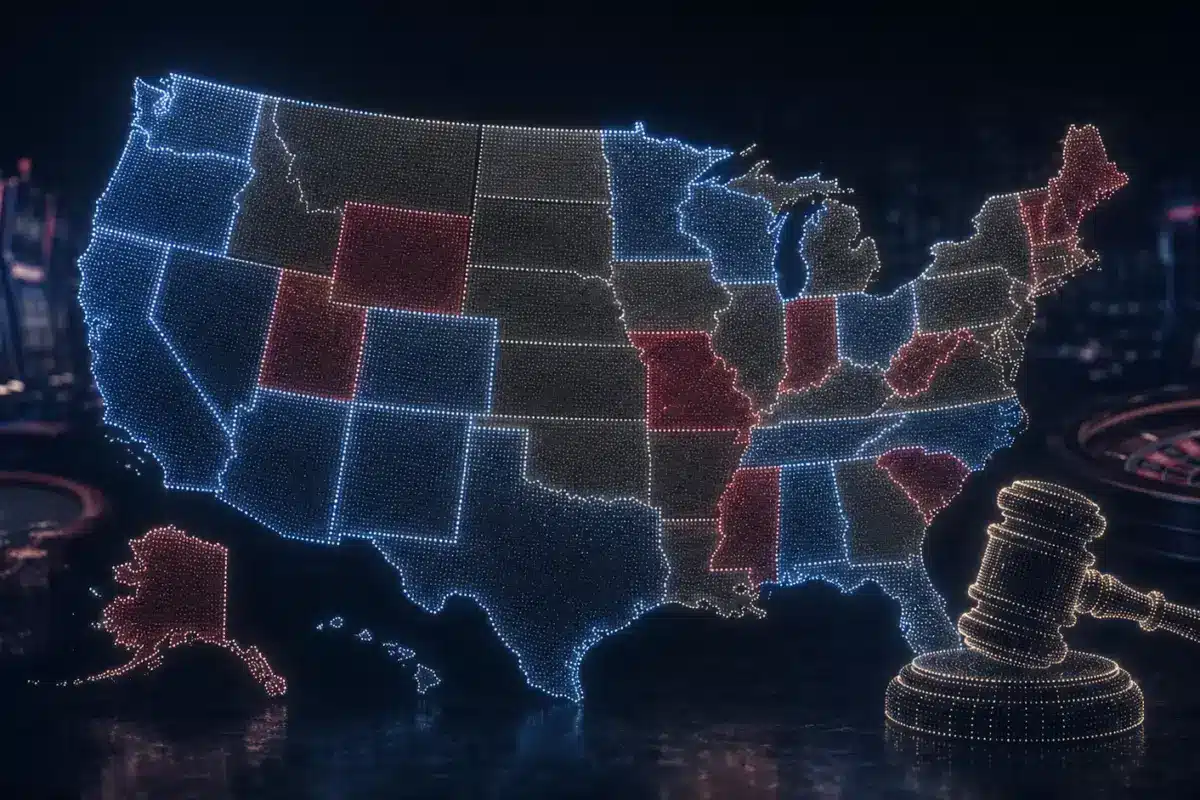
Short answer, friend: it depends entirely on your state, and the map is changing almost weekly. As of 1 September 2026, sweepstakes casinos are banned or blocked in 14 states, with one more ban already signed and due in November — while around 35 states still permit them with no specific ban. There’s no federal ban; legality runs state by state under each state’s gambling and sweepstakes code, and the whole model exists because of the federal “no-purchase-necessary” (AMOE) doctrine.
One thing to settle up front, because it’s the question that scares people: these bans target operators, not players. No banning law creates a player-side criminal offence — you are not breaking the law by having played. The real trade-off is where you go next, and we’ll be straight about that below rather than cheerleading the offshore route. This page is a living tracker; treat every status as “as of July 2026” and re-check before you act.
Sweepstakes Casino Bans — State-by-State (as of September 2026)
| State | Status | Law / Bill | Effective |
|---|---|---|---|
| California | Banned | AB 831 (signed Oct 11, 2025) | Jan 1, 2026 |
| New York | Banned | S05935A (signed Dec 2025) | Immediate |
| New Jersey | Banned | A5447 (signed Aug 15, 2025) | In effect |
| Connecticut | Banned | Statutory ban | In effect |
| Montana | Banned | SB 555 (the first, 2025) | 2025 |
| Nevada | Banned | Pre-existing gambling code | In effect |
| Indiana | Banned | HB 1052 (up to $100k/violation) | Jul 1, 2026 |
| Tennessee | Banned | SB 2136 + AG cease-and-desist | Signed May 22, 2026 |
| Washington | Banned (enforcement) | Online gambling = Class C felony | In effect |
| Michigan | Banned (enforcement) | Regulator enforcement action | In effect |
| Idaho | Banned (enforcement) | Pre-existing gambling code | In effect |
| Maine | Banned | LD 2007 (signed by Gov. Mills, 6 Apr 2026) | In effect — Jul 14, 2026 |
| Louisiana | Banned | HB 53 + HB 883 (signed by Landry, May 2026) — racketeering framework | In effect — Aug 1, 2026 |
| Oklahoma | Scheduled | SB 1589 (veto overridden; felony) | Nov 1, 2026 |
| Iowa | Enforcement | SF 2289 (gives regulator C&D power) | May 15, 2026 |
| ~35 others | Permitted | No sweepstakes-specific ban (TX, FL, GA, OH, AL…) | — |
A note on the “enforcement” rows: Washington, Michigan and Idaho don’t necessarily have a new sweeps-specific statute, but their existing gambling codes are being used to push operators out — the practical effect is the same as a ban. Iowa is a step milder: SF 2289 gives the Racing & Gaming Commission cease-and-desist power rather than an outright prohibition. Statuses and dates shift constantly, so confirm your own state before relying on any of this.
What Triggered the 2026 Crackdown
Louisiana went furthest. Its two 2026 laws do not simply prohibit the games — they fold sweepstakes gaming into the state’s anti-racketeering framework, which lets prosecutors pursue payment processors, software providers and affiliates connected to a sweeps platform, not only the operator. That is a meaningful escalation: most state bans target the operator alone. If you write about, promote or process payments for these platforms, Louisiana is the statute to read.
Sweepstakes casinos ran for years in a grey zone, using the dual-currency model — free “Gold Coins” for play and prize-redeemable “Sweeps Coins” — to sit outside traditional gambling law under the no-purchase-necessary doctrine. Two things ended the truce. First, the model got big and visible, drawing the attention of state regulators and licensed operators who saw untaxed, unregulated competition. Second, Montana moved first in 2025, and once one state passed a clean statutory ban, others had a template. Through 2025 and into 2026 the bills came fast, most defining the dual-currency, redemption-based structure explicitly so it couldn’t hide behind the sweepstakes label. The result is the state-by-state patchwork above.
What Happens to Your Sweeps Coins and Balance
When a ban lands, operators pull out of that state — usually with a wind-down window, though New York’s ban took effect immediately with none. If you’re in a state that’s banned or about to be, the practical steps are simple: redeem any prize-eligible Sweeps Coins balance before the cut-off, and don’t leave funds sitting in an account you’ll lose access to. Check the operator’s notice for your state’s specific redemption deadline, because they vary — some give weeks, some give days. Gold Coins (free-play currency) have no cash value and aren’t redeemable, so there’s nothing to reclaim there. If a scheduled ban (Maine, Louisiana, Oklahoma) applies to you, act before the effective date, not on it.
Where Players Are Going Next — and the Honest Trade-Off
Two destinations are absorbing the overflow, and we’re not going to pretend either is a clean upgrade. The first is offshore and crypto casinos, which take US players in banned states and offer real-money play rather than the sweeps workaround. The second is prediction markets like Polymarket and Kalshi — on-chain prediction volume hit roughly $36B in Q1 2026 and overtook on-chain casino gambling, pulling the same crowd.
Here’s the trade-off, stated plainly. Offshore casinos are the practical fallback in a banned state, but you give up what a regulated or even a sweeps operator offered: state-backed dispute resolution, enforced self-exclusion, and a local authority to complain to. Offshore means Curaçao-level oversight at best, thinner consumer protection, and recourse that rests on the operator’s track record, not a regulator. That can be a fair choice for an informed adult — but go in knowing the protection gap, and read our offshore vs regulated casinos guide before you switch. For the vetted end of that market, see our best crypto casinos USA and best online casinos USA guides, and our Bovada review for the most-established US-facing option.
Are You, the Player, at Risk? No.
This is the part worth repeating because the headlines blur it: none of these bans create a criminal offence for the individual player. Every one of them targets operators — running, offering or assisting a sweepstakes casino — with the penalties (like Indiana’s up to $100k per violation, or Oklahoma’s felony classification) aimed at the businesses, not the people who played. When a ban hits, what happens to you is that the app stops working in your state and you redeem your balance. That’s it. The genuine risks are downstream: if you move to an offshore site, you’re now in the thinner-protection world described above, so choose carefully. State-specific detail lives in our California, New York, Michigan and Maine guides.
Sweepstakes Casino Bans — FAQ
Are sweepstakes casinos legal in my state?
It depends on your state. As of July 2026 they’re banned or blocked in about a dozen states (including California, New York, New Jersey, Connecticut, Montana, Nevada, Indiana, Tennessee, Washington, Michigan and Idaho), scheduled to be banned in Maine, Louisiana and Oklahoma, and still permitted in roughly 35 others. Check the table above and confirm your own state, since the list changes constantly.
Am I breaking the law by playing sweepstakes casinos?
No. Every one of these bans targets operators, not individual players. None of them creates a player-side criminal offence — you are not committing a crime by having played. When a ban takes effect, the operator leaves your state and you redeem your balance.
What happens to my Sweeps Coins balance when a state bans them?
Redeem any prize-eligible Sweeps Coins before your state’s cut-off. Operators usually give a wind-down window (New York was the exception, with an immediate ban and no window), and the deadline varies by operator, so check their notice. Gold Coins are free-play with no cash value, so there’s nothing to reclaim there.
Are offshore casinos safer than sweepstakes casinos?
Not “safer” — different. Offshore casinos offer real-money play and accept US players in banned states, but you give up state-backed dispute resolution, enforced self-exclusion and a local authority to complain to. They run under Curaçao-level oversight at best. They can be a fair choice for an informed adult, but the consumer protection is thinner — read our offshore vs regulated guide before switching.
Will more states ban sweepstakes casinos?
Almost certainly. Once Montana set the template in 2025, bans have come in waves, and several more states have bills filed for the 2026–2027 sessions. Three are already scheduled (Maine, Louisiana, Oklahoma). Treat this as a moving target and re-check your state before you rely on its status.
Is there a federal ban on sweepstakes casinos?
No. There’s no federal ban. Legality is decided state by state under each state’s gambling and sweepstakes code, and the model exists nationally because of the federal no-purchase-necessary (AMOE) doctrine. That’s why the map is a patchwork rather than a single rule.
The Monkey’s Take
The sweepstakes era is being dismantled one state at a time, and the honest read is that it won’t stop soon. If you’re in a banned state, redeem your balance and decide with clear eyes: the offshore/crypto route is the practical fallback, but it trades away the state-level protections you’re losing. That’s a real cost, not a footnote. Whatever you choose, this list will look different next month — so bookmark it, check your state, and never assume last month’s status still holds.
Status as of mid-July 2026 — laws change frequently; confirm your state before acting.
The latest state to act: Oklahoma banned sweepstakes casinos after a veto override.
18+ (21+ where required) · Play responsibly. Problem gambling? Call 1-800-MY-RESET, or the National Council on Problem Gambling helpline at 1-800-522-4700.
Your sweepstakes casino is gone — now what? We set out the three real options for displaced US players, and what each one costs you in protection, in where US players are going next.
Setting a limit before you play is the single most effective habit there is. Our guide to gambling limits that actually stick covers the tools that work and where to get free confidential help.
Comparing jurisdictions? Our where online casino is legal in North America table sets out every US state and Canadian province in one place, with the date each market opened.

Loris Barce is the founder and editor of The Casino Monkey. Based in Italy and writing in English for players in the United States and Canada, he started the site after finding that most casino "reviews" were sales pages with a rating attached. Every score here is built from the operator's own terms, withdrawal checks and attributed complaint data, and he is the one who reads the fine print. When a number can't be verified, he would rather say so than make one up.
Cite this page
Journalists, researchers and other sites are welcome to use this data. Please credit The Casino Monkey and link to this page, so readers can check the sources and the date.
The Casino Monkey. "Sweepstakes Casino Bans 2026 — State-by-State Tracker." Updated September 4, 2026. https://thecasinomonkey.com/guides/sweepstakes-casino-bans-2026/
<a href="https://thecasinomonkey.com/guides/sweepstakes-casino-bans-2026/">Sweepstakes Casino Bans 2026 — State-by-State Tracker</a> (The Casino Monkey)
Spotted an error, or have newer data? Tell us and we will correct the page and the date.